Does twice the batteries mean twice the runtime?
Does twice the batteries mean twice the runtime?
It’s a natural assumption: put in twice as many batteries and get twice the battery life. But is it actually true? For IoT and electronics projects, form factor is often a critical constraint that doesn’t always leave room for additional batteries. On the other hand, projects with more flexibility in their form factor may opt for extra batteries to play it safe on battery life, though at a higher cost. Either way, it comes down to a question of trade-offs. To find out how the math actually works, we used the Otii Battery Life Estimator to model a real-world embedded device and compare two battery configurations head to head.
Defining the device behavior
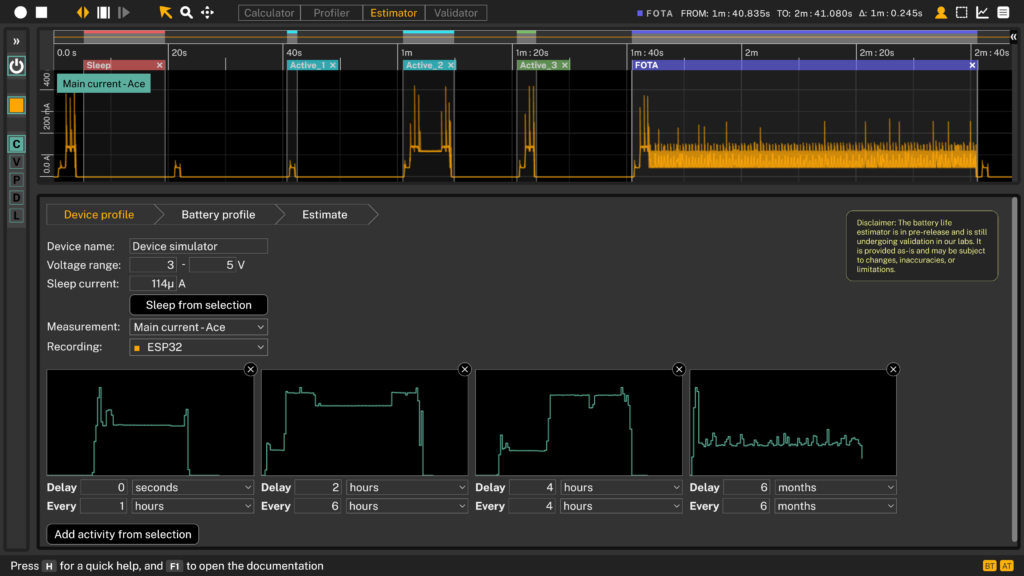
The first step in any battery life estimation is describing how the device actually behaves. In this case, the Device Under Test (DUT) is an ESP32-based temperature sensor. The device wakes up periodically to take a measurement. If the temperature has changed since the last reading, it transmits the data over HTTP wirelessly. Connections are not always instant, sometimes the device needs extra time to establish a link before it can send the sensor data. On top of that, the firmware can be updated over the air (FOTA), which involves receiving a significant amount of data from a server. Therefore it consumes considerably more energy than a routine transmission.
These activities don’t all happen at once, and they don’t happen with equal frequency. The estimator tool lets you distribute each activity over time, building up a realistic picture of the device’s energy consumption across a full duty cycle.
Selecting the battery
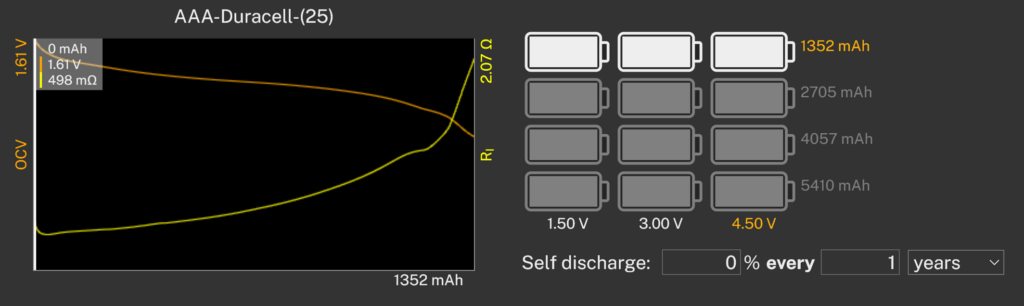
For this estimation, we selected a Duracell Alkaline AAA battery, profiled at room temperature. Since this DUT’s cut-off voltage is 3 V, a single AAA is not sufficient. Three batteries connected in series are needed to meet that requirement. This is referred to as a 3S1P configuration (three series, one parallel), which adds up to 4.5V, 1.352mAh.
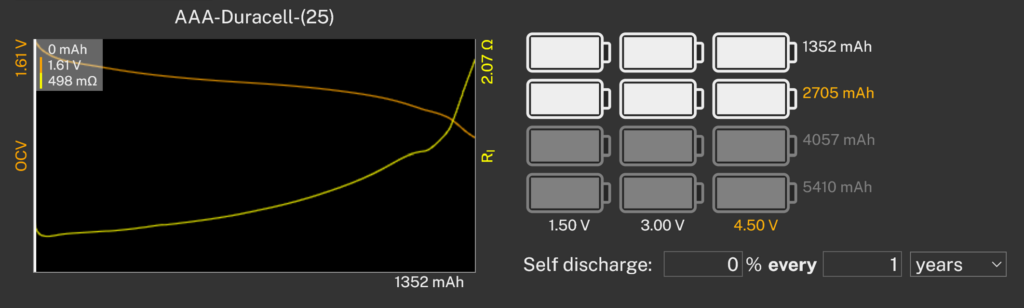
To explore the effect of adding more batteries, we then doubled the pack. We use two sets of three series-connected batteries wired in parallel, giving a 3S2P configuration, adding up to 4.5V, 2.705 mAh. The first setup uses three batteries total; the second uses six.
Running the battery life estimator
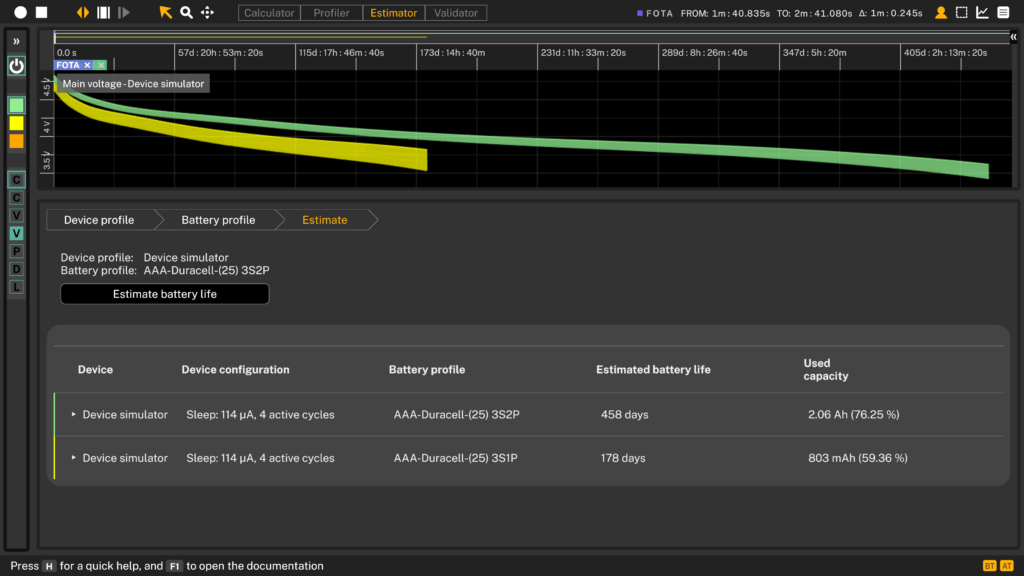
Running the estimator for both configurations produces a result that might surprise you.
| Configuration | Batteries | Estimated battery life | Capacity utilization |
|---|---|---|---|
| 3S1P | 3 | 178 days | ~60% |
| 3S2P | 6 | 458 days | >75% |
The 3S2P configuration lasts 458 days compared to 178 days for 3S1P — that’s 280 extra days, or more than 150% longer battery life. Simply doubling the number of batteries yields far more than double the runtime.
The capacity utilization tells the same story from a different angle: the 3S1P pack uses only 60% of its available energy before the voltage drops below cut-off. The 3S2P pack on the other hand extracts more than 75%. Note that while the battery life is long, the used capacity percentage is comparatively low — likely a consequence of the battery choice. To maximize ROI, you’d want to utilize as much of the available capacity as possible.
Why does this happen?
When batteries are connected in series, the pack voltage increases — which is why three cells in series gives 4.5 V, meeting the minimum 3V needed for the DUT. But when battery sets are wired in parallel, something different happens: the internal resistance of the pack is halved.
Lower internal resistance means the battery pack can deliver current with less voltage drop under load. As a result, the terminal voltage stays above the cut-off threshold for much longer, allowing more of the stored energy to be extracted before the device shuts down. It’s this reduction in internal resistance — not just the increased capacity — that explains why the 3S2P configuration delivers disproportionately more than twice the battery life.
The battery configuration matters
This exercise is a good reminder that battery life isn’t simply proportional to the number of cells — the configuration matters just as much as the count. And in any development project, there are other factors to weigh and trade off as well, such as form factor, size, and cost, all of which play into choosing the battery setup with the best ROI. Measuring and estimating is what turns guesswork into informed decisions.