DC/DC converter efficiency measurements
DC/DC converter efficiency measurements
Maximizing battery life in IoT devices requires careful consideration of how the battery connects to the load. Often, a DC/DC converter is the best choice for providing regulated power in specific applications. This setup enables optimal battery usage and minimal energy waste. The DC/DC converter must be highly efficient to meet the device’s voltage and current requirements.
But how to choose the right DC/DC converter? While datasheets provide an overview, characterizing its efficiency within the system is best. This tech article demonstrates this process.
System under the test
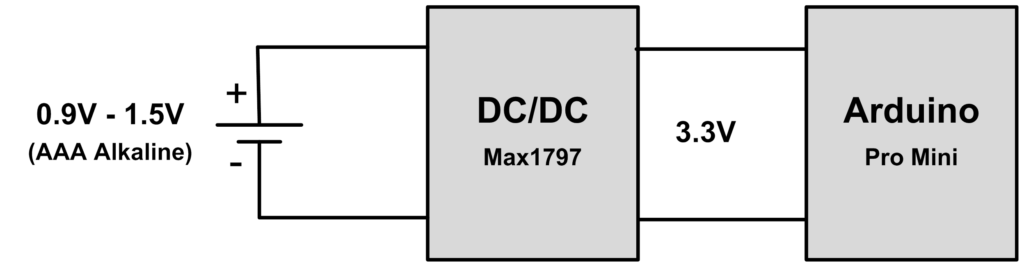
We investigate the DC/DC efficiency of a system comprising a 1.5V Alkaline battery and a DC/DC converter that boosts the voltage to 3.3V for an Arduino Pro Mini (see Figure 1). The timer on the Arduino board starts the system at certain intervals. During these power-on intervals, we want the system to run as efficiently as possible. We want the system to leverage the DC/DC converter’s high efficiency in the 1–10 mA range (active mode) throughout the battery life cycle, while accounting for decreasing battery voltage over time. For systems where sleep-mode power consumption dominates active-mode power consumption, the DC/DC efficiency is less important.
Battery characteristics
When connecting a load RL to a battery with unloaded voltage E, the voltage across the load will drop due to the battery’s internal resistance Ri. The battery voltage, U, will decrease as the current into the load increases due to the voltage drop over the internal resistance. Coin cell batteries and AAA batteries have high internal resistance, so they cannot be loaded with high current, as the output voltage would be too low.
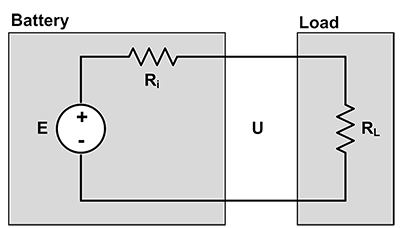
If the load is resistive, as with a simple resistor, the current drawn from the battery decreases as the battery discharges and its voltage drops. When a DC/DC converter is connected to the battery and presents a fixed output voltage to the same load, the current drawn from the battery increases as the battery voltage drops. This will accelerate discharge, cause the voltage to drop further, leading to an even greater increase in current, and so on.
DC/DC converter under test
In the datasheet (see figure 3) for the DC/DC converter we use here, efficiency is presented as a function of load current at a specific voltage, 1.2V in this case. Additional information would be useful, for example, the efficiency for the range of ~0.8V – 1.5V. It would be great to have this curve as a function of the current drawn from the battery, with DC/DC self-consumption and component losses (mainly the inductor) included.
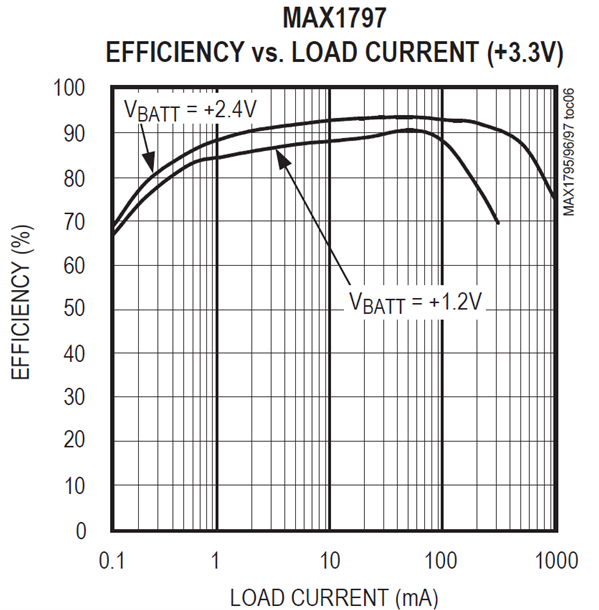
As the voltage drops, the current drawn from the DC/DC converter increases, leading to a decrease in the battery’s voltage (note that we are only checking behavior at room temperature in this study). The efficiency of a step-up DC/DC converter typically decreases as the input voltage decreases.
Characterization of the DC/DC converter
For this DC/DC characterization, the measurement setup comprises an Otii Arc as the system’s power supply, which also serves as a battery and current measurement instrument. Otii Arc can supply the system while measuring both input voltage and current, as well as the output voltage and current from the DC/DC converter. The efficiency is calculated by dividing the output power by the input power.
To measure the output current from the DC/DC converter, a sense resistor is needed, see Figure 4. The resistor’s value must be high enough to provide sufficient resolution for the measurement, but low enough not to introduce a large voltage drop or exceed shunt voltage limits.
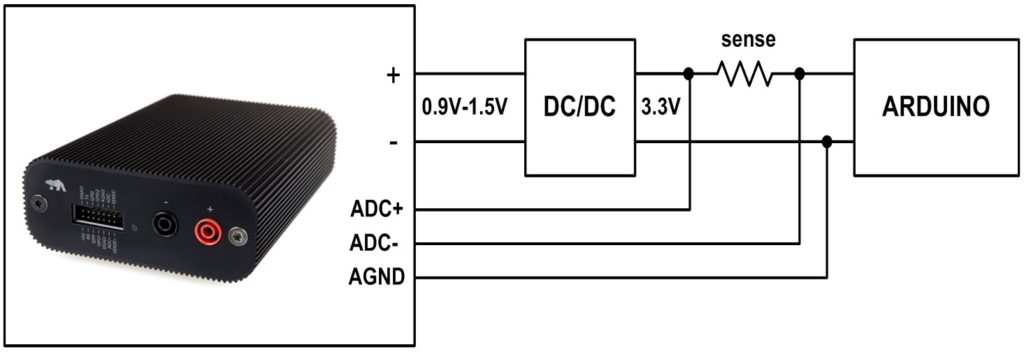
In this example, a 4.7 ohm sense resistor is used. This will result in a 37 mV voltage drop at 8 mA, which will not affect the Arduino’s performance. Otii’s ADC expansion port voltage range is -81.9175mV to 81.2mV, so 37mV is well within this range.
A simple application runs on the Arduino Mini, flashing an LED while measuring the DC/DC efficiency for that specific use case.
Although measurements can be conducted manually, we chose to save time by automating the process of setting input voltages from 1.5V (fully charged battery) to 0.9V (almost empty) and calculating the DC/DC converter efficiency over time to reflect a real use case. The automation is scripted in Python, C#, or another language using Otii Automation Toolbox.
Between each measurement, we disabled the power supply to reset the system. By doing this, you can see the entire startup phase and the system’s active phase.
Results
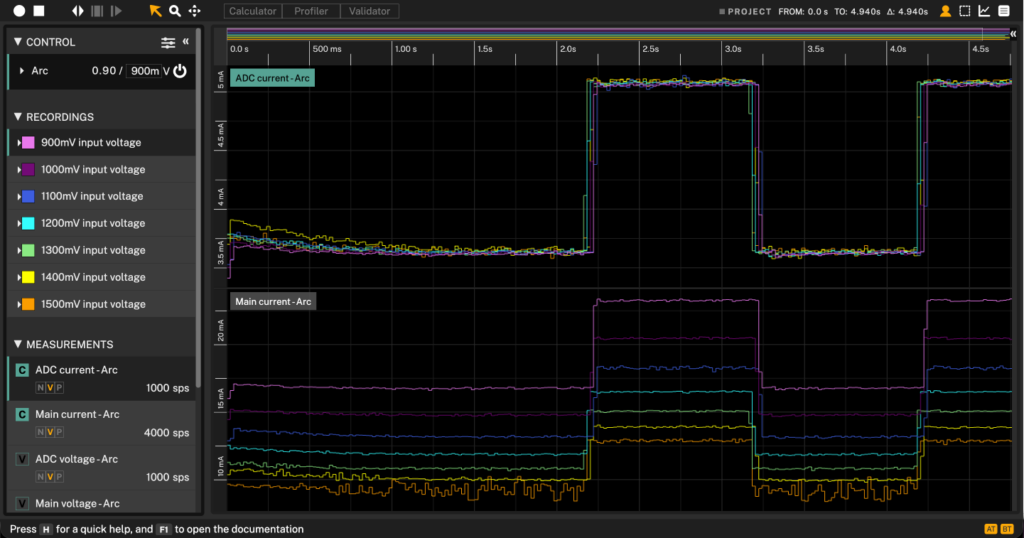
Figure 5 shows that the output current from the DC/DC converter (ARC ADC Current in the figure) remains relatively constant across input voltages. The results are expected as long as the DC/DC converter operates as designed. However, the input current (ARC Main Current, see Figure 5) increases when the input voltage decreases.
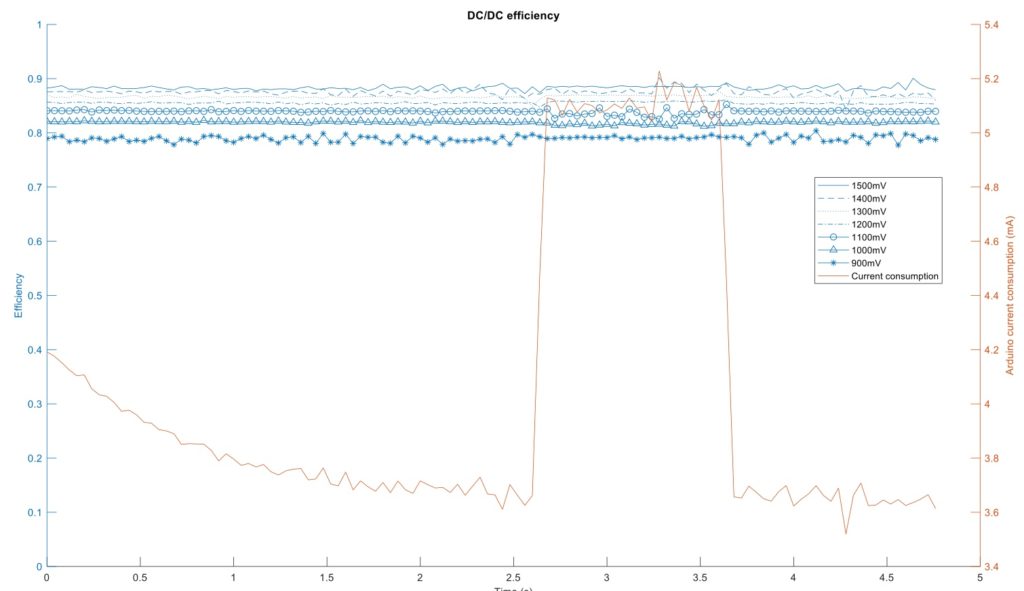
Figure 6 shows the DC/DC efficiency for different battery voltages. The average DC/DC converter efficiency varies a lot with battery voltage. At 1.5V, the efficiency is more than 87%, while at 0.9V, it has dropped below 79%. Arduino acts as a load, consuming roughly 5.1 mA when the LED is on and 3.6 mA when it is off. As expected, the data sheet values provide a good indication of this for higher battery voltages; however, for lower voltages, this data is not provided. Hence, the importance of characterization is apparent.
Conclusions
Battery-powered embedded and IoT devices typically stay in sleep mode, using minimal power and waking up only for short, power-intensive tasks. Each product type has a unique activity profile and design. No single power supply design fits all products. Hence, to find the right solution for your product under development, you need to characterize the battery and load, design power management, and validate the entire system.
This tech article demonstrates how to characterize a DC/DC converter for an electronics design example. The DC/DC converter datasheet provides performance specifications that are typically limiting. Characterizing its efficiency across the whole system is the best low-power mindset approach, and it’s simple with the Otii tools. Looking to analyze the efficiency of DC/DC or PMICS? This application note will help you get started.